Sedimentation Studies Apparatus Manufacturer,Supplier and Exporter in India
Product Code : EL-TWL-11763
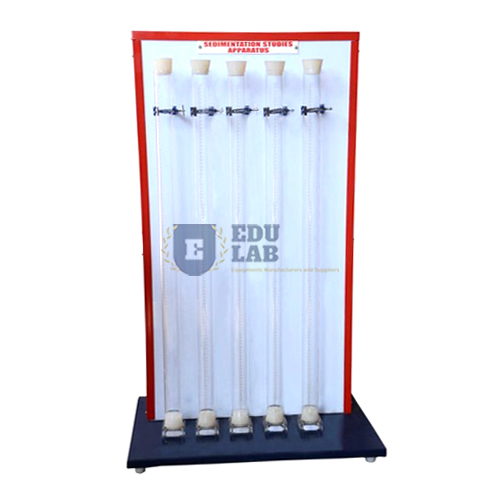
Quick Answer: The Sedimentation Studies Apparatus uses 5 graduated borosilicate glass cylinders to study zone settling of slurries at different particle concentrations. Interface heights are timed with a stopwatch as the settling zones develop.
Last updated: October 2026
Key Features
5 graduated cylinders in borosilicate glass.
Cylinders lift out for cleaning.
Studies zone settling as it depends on particle concentration and characteristics.
Rate of change of liquid/solid interface heights measured against time with a stopwatch.
Shows clear liquid, transition, slurry and sludge zones forming in a settling slurry.
Technical Specifications
Specification
Value
Cylinders
5, graduated, removable
Cylinder material
Borosilicate glass
Timing
Stopwatch
Study
Zone settling versus concentration
About This Product
A slurry left undisturbed in a cylinder separates into a clear supernatant layer, a transition zone, a slurry zone and a concentrated sludge zone. As time passes the zone heights change until only clear liquid and sludge remain; after this critical point the sludge slowly compresses under its own weight. Filling the cylinders at different concentrations shows how mutual interference in hindered settling slows the settling rate compared with free settling of single particles.
Frequently Asked Questions
How many cylinders does the apparatus have?
It has 5 graduated cylinders made of borosilicate glass, and each can be removed for cleaning.
How is the settling rate measured?
The height of each liquid/solid interface is read on the graduated cylinder and timed with a stopwatch, giving the rate of change in height with respect to time.
What zones form during the test?
A clear supernatant layer, a transition zone, a slurry zone and a concentrated sludge zone. Eventually only clear liquid and sludge remain, and the sludge then compresses under its own weight.