Ion Exchange Unit Manufacturer,Supplier and Exporter in India
Product Code : EL-EELE-11388
Quick Answer: The Ion Exchange Unit passes water through cation and anion resin beds, with a conductivity meter on the outlet of the second bed giving a continuous reading as demineralisation proceeds.
Last updated: October 2026
Key Features
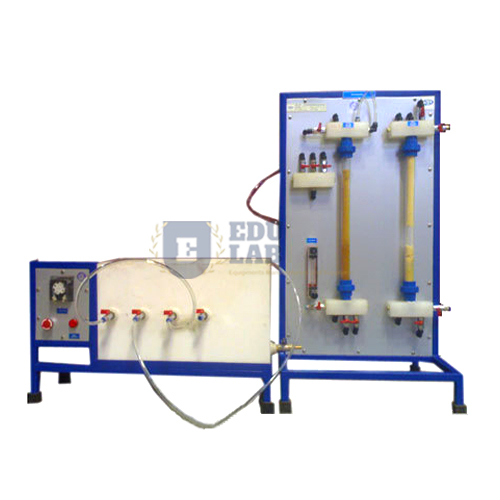
Supplied with commercial cation resin (1 litre) and anion resin (0.75 litre).
Conductivity meter on the outlet of the second ion exchange bed.
Self-priming diaphragm pump with control valve and flowmeter, 10-80 ml/min.
Separate sumps for regenerant, test and wash solutions, selected with a traversing tube.
20-litre sump tank for effluent.
Other ion exchange materials can be fitted for comparison.
Technical Specifications
Specification
Value
Cation exchange resin
1 litre
Anion exchange resin
0.75 litre
Flowmeter range
10-80 ml/min
Sump tank capacity
20 litres
Pump
Self priming, diaphragm type
About This Product
Students run a solution through the beds, follow the outlet conductivity, then regenerate and wash the resins with solutions picked by the traversing tube. Water collected in bottles can be tested for hardness, conductivity or dissolved solids, and other exchange materials can be tried so that their exchange capacity is measured and compared. Colleges and TVET centres in Gambia, Paraguay, Malaysia, Australia, Armenia and Togo can source the Ion Exchange Unit from Educational Lab Equipments.
Frequently Asked Questions
Which resins are supplied?
Typical commercial cation and anion resins: 1 litre of cation exchange resin and 0.75 litre of anion exchange resin.
How is the progress of demineralisation followed?
A conductivity meter connected to the outlet of the second ion exchange bed gives a continuous indication.
Can other exchange materials be tested?
Yes. Other ion exchange materials may be used so their characteristics and exchange capacity can be measured and compared.